-

Ryan O’Hanlon
Multiple Authors
We are back for Year 2. Of what? Of identifying the best — and worst — players in the Premier League at a broad array of some general and some specific skills.
Who is the fastest runner? Who is the fastest older guy? Who is the worst passer under pressure? Who wins 50-50 duels most often? Can we agree on the best athlete? The worst athlete? The most reliable goalkeeper? The most one-footed player? Which defender never makes mistakes? Who is the worst final-third decision-maker?
Using the unique, fine-grain dataset provided by Gradient Sports, we can answer all of those questions, and I’m going to answer all of them down below — except for the last one. That one, I’m going to answer up here.
Which attacker has taken the most shots, per Gradient’s analysis, when there was a better passing option available? That would be Liverpool’s Dominik Szoboszlai, with 26.
But among players with at least 10 bad shooting decisions, who is using up the highest percentage of their attempts on shots where someone else was open? That would be Manchester City’s Nico González: 83.3% of his shots were attempted when there was a better option for a pass.
Compare that to his teammate, someone he could be passing the ball to, Erling Haaland. The Norwegian leads the league in shots with 91 — no one else has even reached 65 — and yet only eight of those have come when someone else was in a better position.
Want more stats like that? We’ve got 25 more specific (and somewhat arbitrary) superlatives for you, so let’s get to it.
– Ranked: The top 25 manager jobs in soccer, from best to worst
– Premier League’s 50 worst transfers of all time: Who is No. 1?
– Liverpool at a crossroads: Where has it gone wrong since title win?

 Fastest player: Jackson Tchatchoua, Wolverhampton Wanderers
The worst team in the league also employs the fastest player in the league. Tchatchoua’s max speed, which Gradient defines as the average of each player’s five highest speeds sustained for a full second, is 35.78 kilometers per second.
That’s nearly 0.4 km/s more than Chelsea’s Pedro Neto in second. The gap between Tchatchoua and Neto is bigger than the gap between Neto and sixth-placed Haaland.
 Slowest player: Tom Cairney, Fulham
This should not be viewed so much as a criticism of Cairney’s average speed — a mere 28.35 km/s. He’s a possession midfielder who was never fast to begin with and is now 35.
Rather, this is a chance to highlight the revival of Casemiro, who was the slowest player in the league last season but has raised his pace up to 29.85 km/s. Now Casemiro is just one of the slower players in the league.
 Fastest ‘old’ guy: Kyle Walker, Burnley
So far this season, 21 players have recorded a max speed of at least 34 km/s. Nineteen of them are 25 or younger, 20 of them are 28 or younger, and one of them is Walker, who is 35 years old and has a max speed higher than all but six other players in the league.
It’s been a disappointing season for Lewis-Skelly who, at this time last year, seemed like he was on the fast track to starting for England at the World Cup. While he’s technically brilliant, his lack of athleticism has kept him off the field this season, and it’s going to be the biggest hurdle for him to overcome if he is to fulfill the potential it looked like he had a year ago.
The 19-year-old’s max speed of 28.65 km/s is the third slowest in the league this season among outfielders, and the slowest among players under 28 years old.
 Best passer: Bruno Fernandes, Manchester United
Gradient has a team of analysts that grade a number of different actions undertaken by every player in the Premier League every weekend. Every pass, shot, etc. is awarded a score between minus-2 and plus-2 (in increments of 0.5), and those numbers are normalized across the league on a scale of 0 to 100.
Fernandes has been the best passer in the league this season, with a mark of 98.6, and I think he has a decent case as the best player in the league right now. Remember when everyone was wondering if Manchester United should let him go last summer?
 Worst passer: Dan Burn, Newcastle United
Burn has a perfect name, is a gigantic human being and has somehow turned himself into a Champions League-level defender after turning 30.
Burn has many positive characteristics, but “the ability to pass a soccer ball” is not one of them. He has earned a 46.9 passing grade so far this season. He’s completing about 77% of his passes this year — a number you’d expect from a center forward, not center back.
 Best passer under pressure: Rayan Cherki, Manchester City
While Manchester City manager Pep Guardiola clearly still doesn’t trust him — or rather, doesn’t want to trust him — Cherki is so good once the ball gets to his feet. He’s one of five players with a 90 grade or better at passing under pressure, along with Moisés Caicedo, Adam Wharton, Jérémy Doku, and Leandro Trossard.
Worst passer under pressure: Dan Burn, Newcastle United
Sorry, Dan — I don’t make the grades! Though in the overall passing grade a couple of goalkeepers graded worse than Burn, he’s the lowest graded player at any position for under-pressure passing.
One other potentially interesting note from the bad-under-pressure passers category is that Arsenal’s Gabriel Magalhães grades out at a 52.7, third worst among 92 qualifying center backs. A potential weakness to exploit for anyone who plays the best team in the world over the next couple of months?
It felt like Gravenberch unlocked a new level of play for Liverpool last year. And despite his team’s wild inconsistency this season, I think the 23-year-old has been just as good, if not better, in his second year as a full-time starter.
He’s leading the league in the ball-carry grade for the second straight year: a 90.5, while no one else in the league is above 86. He has also received the ball while opening his body 213 times — tied for most in the league.
Gravenberch’s ability to turn through pressure and carry the ball past defenders might be the only reliable and repeatable movement we’ve seen from Liverpool this season.
Slowest ball carrier: Jérémy Doku, Manchester City
Doku wins this award for the second year running, but he is actually playing a little quicker than he did last season: down to 2.68 seconds per ball possession, from just over 3.0 last year. That might seem trivial, but I think the slight pickup in pace is part of his larger transformation from a player who racks up incredible advanced statistics, but doesn’t help his team win, to a guy who is a genuinely winning player.
Best through ball passer: Jérémy Doku, Manchester City
We know Doku is one of the — if not the — deadliest dribblers in the world, and this season he has been one of the most incisive passers in the world, too.
His 95.3 through ball passing grade is by far the best in the league, ahead of Martin Ødegaard’s 88.8 mark in second place. Now if only he could figure out a way — or be allowed — to take more than 12 total shots through 25 matches …
 Best set piece taker: Anton Stach, Leeds United
Yes, I know, the name everyone was expecting. Stach has attempted four free kicks this season: Two were scored, one was saved and the fourth was a disguised long-range fake-cross that he nearly sneaked past the goalkeeper from 40 yards out.
Obviously, four attempts isn’t enough to award “best free kick taker” with any confidence, but all of Stach’s shots have been high-quality.
The best free kicks, of course, go to Szoboszlai. He’s the only player with a 2.0-graded free kick. See, below:
And he’s the only player with two free kicks graded at 1.5 or better:
His grade isn’t as high as Stach’s because he missed a penalty against Burnley, and he has also smashed a bunch of balls into the stands or nearly out for throw-ins. But once you rope in all of his shots, he actually grades out as the best shooter (90.7) in the league.
 Worst shooter: Adam Wharton, Crystal Palace
Wharton is good at so many things, but shooting has not been one of them:
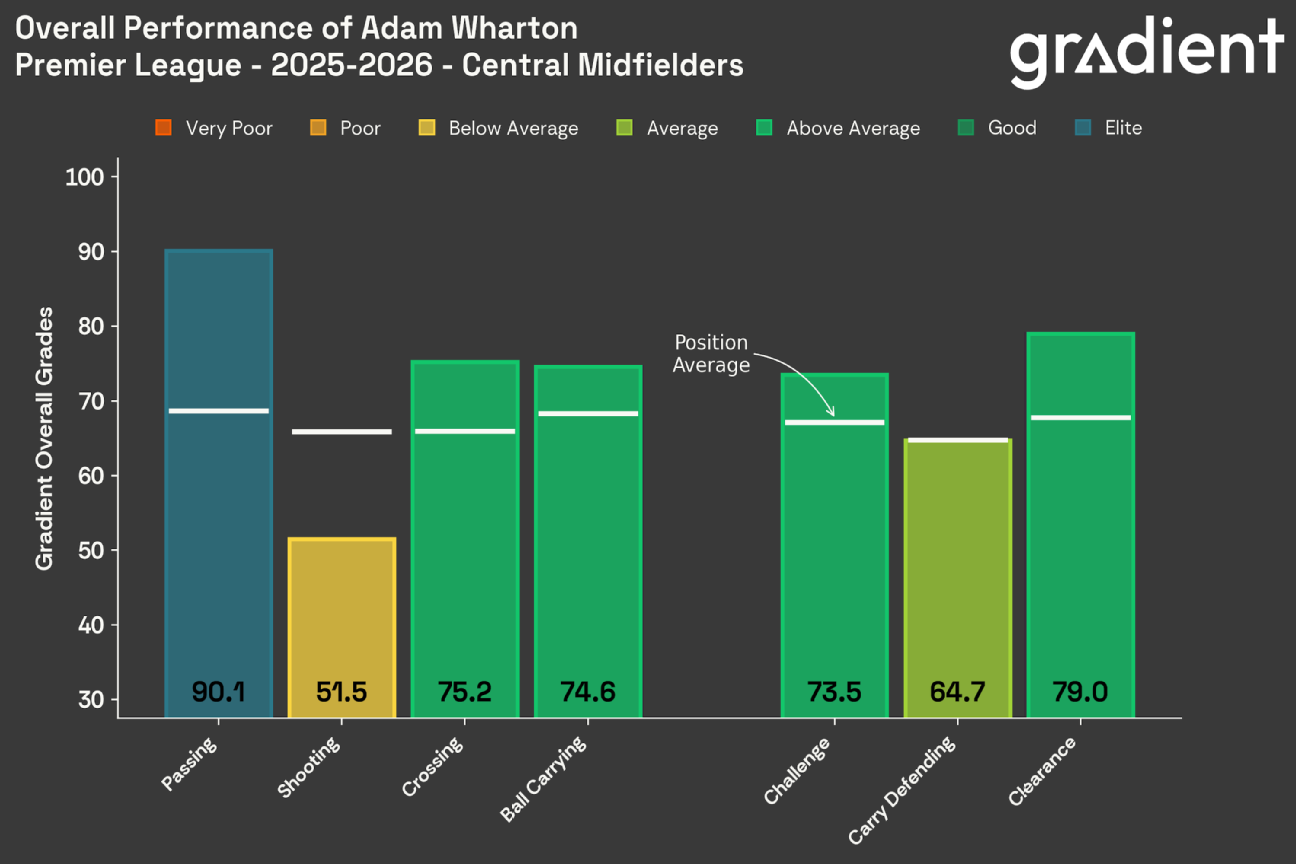
Among all players who have attempted at least 10 shots this season, he has been the worst: one with a neutral grade, five with a minus-0.5, five with a minus-1.0 and one with a minus-1.5 where he, well, yeah, I have no idea what happened here:
Of course, he also played the through ball that led to the even bigger miss right before his.
Most athletic: Daniel Muñoz, Crystal Palace
Gradient created a catch-all athleticism score that looks at a number of physical metrics — a combination of speed, endurance and acceleration ability — for every player on a minute-by-minute basis. This score controls for whether they were a starter or a sub, what position they play and how tall they are.
Normally, I wouldn’t say whoever scores best here is the best athlete in the league, but then I saw that Muñoz has an athleticism score of 99.6 out of 100 I’m totally fine saying that he’s the best athlete in the Premier League. Have you seen the dude play? He’s everywhere, all the time, at top speed.
Least athletic: André, Wolverhampton Wanderers
Before he came over from Brazil, André was being linked with a number of top clubs in England. And while we never actually know the reasons why any given player ever joins Wolves, it seems reasonable to say that the reason André plays for Wolves and not Liverpool is that his athleticism rating is a 0.7 out of 100.
Most reliable goalkeeper: Gianluigi Donnarumma, Manchester City
Using statistics to judge goalkeeper performance should be easy. Thanks to expected goals, you can just look at the rate a shot is typically converted, flip the number inside out and see which keepers are giving up fewer goals than expected from all of the shots they face.
But that doesn’t quite work from season to season because these models are designed to predict how often a goal is scored, not how often a shot is saved, and because the profile of shots a given goalkeeper faces drastically changes with each passing year. Shot-stopping is such a reactive performance category that goalkeeper skill really plays only a partial role.
Anyway, a recent study by Gradient found that the percentage of times a keeper received a negative grade while facing a shot tended to be the most stable metric for predicting keeper performance. And I actually think that makes intuitive sense; while we remember the amazing saves, the real job of a keeper is to not make mistakes — over and over and over again.
This season, Donnarumma is the only starting keeper who has not made a mistake while facing a shot.
Least reliable goalkeeper: Bernd Leno, Fulham
The 33-year-old German has made seven mistakes while facing shots this season. That’s both most in the league overall and most in the league as a percentage of the shots he has faced: 6.5%.
Gradient’s “challenge” grade basically looks at any moment a player attempts to win a ball where possession is contested: a loose ball on the ground, a cross played into either box, a long ball up the field.
Van Dijk is facing more contested balls than ever before in his Liverpool career this season, so he has made more mistakes than usual, but he has also been way more successful in these situations overall than anyone else would be. He leads the league with a 96.6 challenge grade, and he has the most positively graded challenges in the league.
 Worst ball winner: Mohamed Salah, Liverpool
Gradient also looks at 50-50 balls — specific moments where they deem that each player has an equal opportunity to win possession. The worst-rated players here are all forwards and wingers, but bottom of the pile is the reigning Premier League Player of the Year, with a 50.6 grade on 50-50 balls. He has always been toward the bottom of the league for this metric, but he has never been this far down.
 Best defensive positioning: William Saliba, Arsenal
It’s strange that we haven’t reached a “best” Arsenal player until now, but that feels right, in a way. They’re the only team in the league that I would actually describe as “competent” or “reliable.” They’re an all-time great defensive and set piece team, and then they’re just good at everything else. There’s no standout attacker on the team this season, and their best defender stands out by, well, not standing out.
Saliba’s excellence doesn’t really show up in what he does, but rather what he doesn’t do. Among all defenders, he has made the fewest positional mistakes (0.51) per 30 minutes out of possession. Not far behind him is Gabriel Magalhães, who rates out as fourth best with 0.74 mistakes per 30.
 Worst defensive positioning: Reece James and Malo Gusto, Chelsea
Maybe it’s a system thing, but Chelsea’s right backs, James (3.89) and Gusto (3.12), are the only two defenders in the league making more than three positional mistakes per 30 minutes out of possession. Among center backs, the leader is Liverpool’s Ibrahima Konaté with 2.4.
Best crosser: Declan Rice, Arsenal
If I had to sum up this season with a single fact, it would be this: Declan Rice is the best crosser in the Premier League.
Why? Well, it tells us that someone on Arsenal is better at swinging the ball into dangerous areas than anyone else in the league, and it tells us that specific person is a large, physically dominant midfielder, and it tells us that Arsenal can afford to have a large, physically dominant midfielder not be one of the people to whom the ball is being crossed because they have a bunch of other large, physically dominant players who can run into the box instead.
Take a look at this graphic, which plots the challenge and crossing grades of all Premier League players:
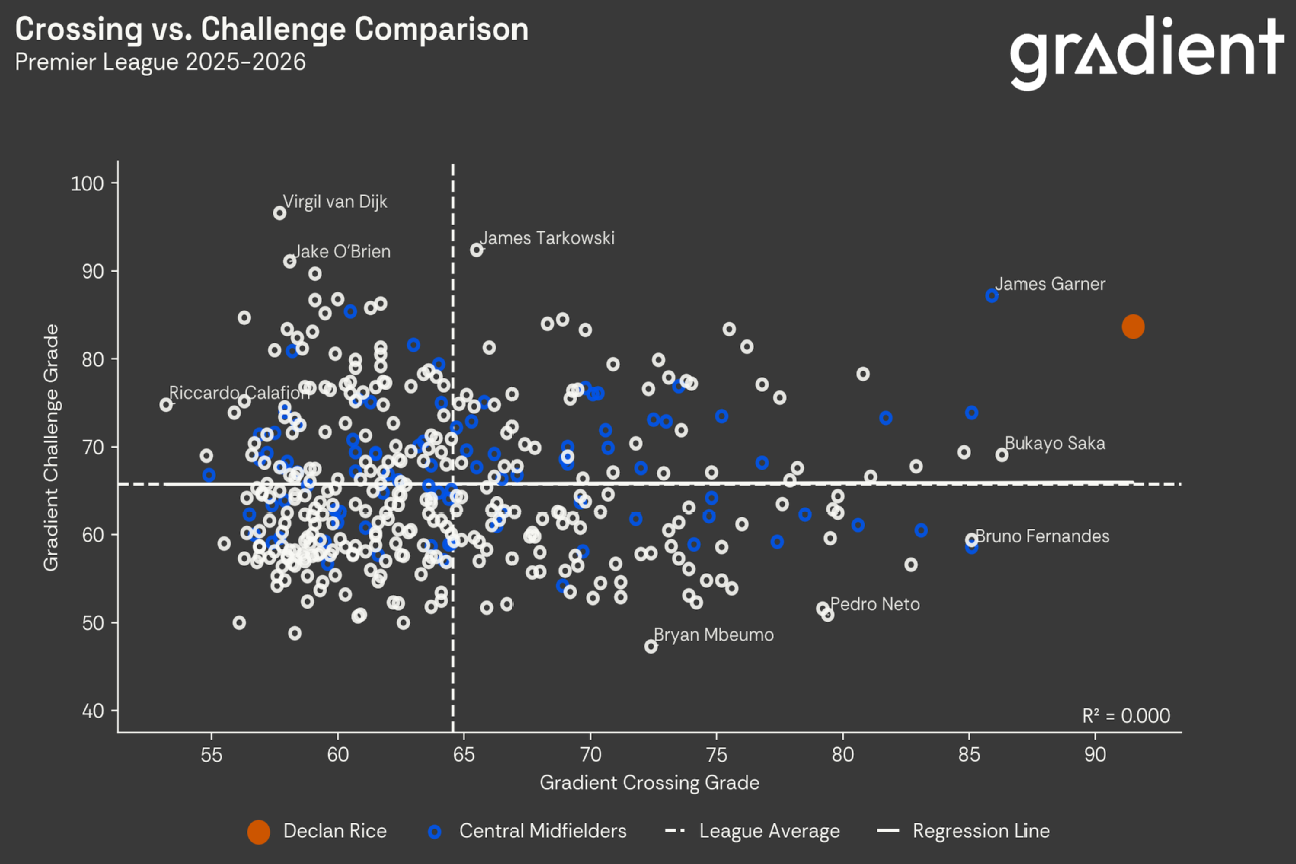
There is no statistical relationship between being good at winning the ball and being good at crossing the ball. And yet Arsenal have a player who does both things at an elite level. That’s why they’re probably going to win the Premier League: they’re as skilled and as solid as anyone else.
 Most two-footed player: Georginio Rutter, Brighton
For the second year running, it’s Rutter, who uses his right foot 39.2% of the time, just edging out Antoine Semenyo, who uses his right foot 65% of the time, as the ambipedal champion of England.
Interestingly, with Semenyo, plus the now-injured Josko Gvardiol and the recently acquired Marc Guéhi, Manchester City have three of the six most two-footed players in the league.
Least two-footed player: Nico O’Reilly, Manchester City
While at Liverpool, Jurgen Klopp spoke about his desire for players with extreme characteristics. He wanted guys that were really good at one or two things, and then he’d find a way to cover up their weaknesses. Is something similar happening at City, where you need to be either extremely two-footed or extremely one-footed?
O’Reilly uses his right foot only 3.3% of the time, while Phil Foden and Bernardo Silva are similarly left-foot dominant. Nico González, meanwhile, uses his right foot 94.5% of the time.